
There is a quiet but growing conversation happening inside European boardrooms. It is not loud. It is not urgent yet. But it is real — and consulting firms, healthcare organizations, and pharma companies would do well to pay attention.
The question being asked is simple: Can we trust that our data, stored with US-based cloud providers, is truly protected from foreign government access?
The answer, it turns out, is legally complicated.
What Is Actually Happening
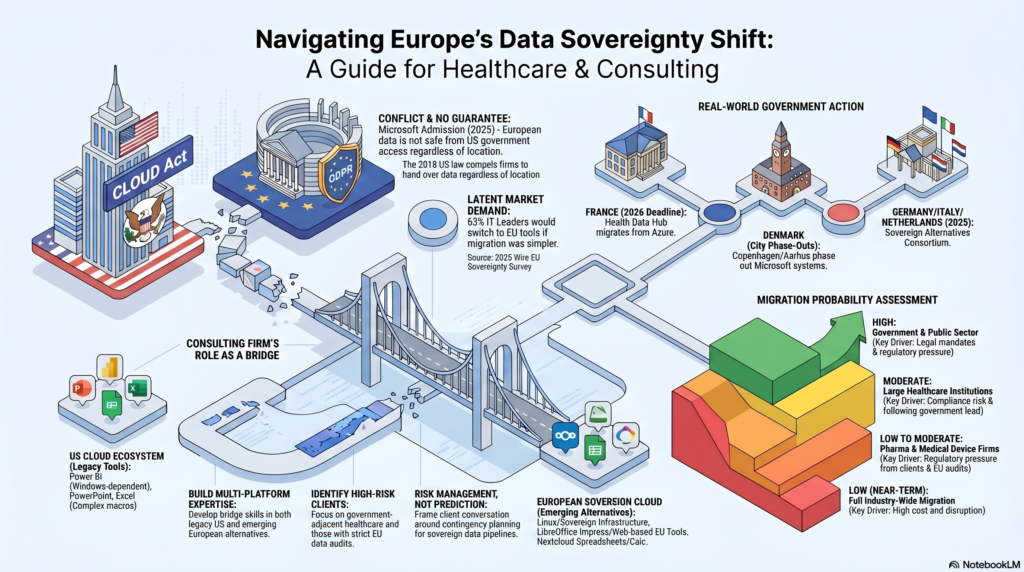
In June 2025, Microsoft’s own lawyer confirmed under oath before the French Senate that the company cannot guarantee that European data stored on its servers is protected from US government access. The reason is the US CLOUD Act (Clarifying Lawful Overseas Use of Data Act), a 2018 law that compels US-headquartered companies to hand over data to American law enforcement — regardless of where that data physically sits.
This creates a direct and uncomfortable conflict with the EU’s General Data Protection Regulation (GDPR), which requires that personal and sensitive data be handled with strict controls and legal justification before any disclosure.
For European organizations — especially those in healthcare, pharma, and medical devices — this is not an abstract legal debate. It is a compliance and reputational risk sitting inside their existing infrastructure.
Government Action Is Already Underway
Several European governments have moved beyond discussion and into action:
- France has issued a legally binding deadline for its Health Data Hub to migrate away from Microsoft Azure, with 2026 as the target year. This migration is being watched across Europe as a test case.
- Germany, France, Italy, and the Netherlands jointly established the European Digital Infrastructure Consortium in July 2025 to develop sovereign alternatives to US digital tools.
- Denmark’s two largest cities, Copenhagen and Aarhus, have announced plans to phase out Microsoft systems — citing both data concerns and geopolitical tensions.
- Nextcloud, a European cloud collaboration platform, reported more than triple the demand for its products from European organizations in early 2025.
These are not fringe movements. They represent a structural rethinking of digital infrastructure at the governmental level.
How Likely Is a Real Migration? An Honest Assessment
Here is where we need to be practical.
Widespread migration away from Microsoft by private sector organizations — particularly in pharma and medical devices — is not imminent and is not guaranteed. The barriers are significant:
- Microsoft tools are deeply embedded in workflows. Replacing them is expensive, disruptive, and time-consuming.
- Microsoft itself is actively responding. It has expanded its EU Data Boundary initiative and is working to offer more in-country data processing options.
- Many legal experts argue that existing frameworks like the EU-US Data Privacy Framework adequately mitigate transfer risks for most use cases.
- Staff retraining, IT infrastructure changes, and workflow disruption can cost more than the perceived sovereignty benefit.
That said, dismissing this trend entirely would be a mistake. Here is a realistic way to think about probability:
| Scenario | Likelihood | Driver |
|---|---|---|
| Government and public sector organizations migrate | High | Legal mandates, regulatory pressure |
| Large healthcare institutions begin evaluating alternatives | Moderate | Compliance risk management, following government lead |
| Pharma and medical device firms shift core infrastructure | Low to Moderate | Regulatory pressure from clients, EU audits |
| Full industry-wide migration from Microsoft tools | Low (near-term) | Too costly, too disruptive without clear mandate |
The most probable near-term scenario is selective migration — organizations moving sensitive data workloads to sovereign infrastructure while keeping Microsoft tools for internal operations where the risk is lower.
Why Healthcare and Pharma Should Pay Attention Anyway
Even if your organization decides to stay on Microsoft, there are indirect pressures building that are worth monitoring:
Regulatory cascades. When government healthcare systems migrate, they often set new standards that flow downstream to their private sector partners. A pharma company submitting data to a French public health authority may eventually face questions about the sovereignty of that data pipeline.
Client-driven requirements. Consulting firms serving European healthcare clients may begin receiving RFPs that explicitly ask for non-Microsoft delivery options. Being unprepared for that question is a competitive disadvantage.
Audit and liability exposure. As GDPR enforcement has intensified, data protection authorities are scrutinizing not just breaches but structural compliance risks. Using a platform that cannot guarantee sovereignty could become an audit finding.
Market signalling. The fact that 63% of European IT and compliance leaders said they would switch to EU tools if migration were simpler (Wire EU Sovereignty Survey, 2025) tells you something about latent demand. The willingness is there. The friction is what is holding them back.
What Does This Mean for Consulting Deliverables?
For consulting firms providing data services to healthcare and pharma clients, this shift — even if partial — has practical implications across three core deliverable types:
Dashboards and Data Visualization
The most direct impact. Power BI does not run on Linux and has no standalone desktop application outside the Windows ecosystem. If clients migrate to Linux-based infrastructure or away from Microsoft Azure, their current Power BI dashboards simply will not work in the same way. Alternatives exist — and some are quite capable — but they require planning, migration expertise, and client education.
Read our dedicated analysis: Dashboard Tools Beyond Power BI — What European Healthcare Firms Should Know
Presentation Deliverables
PowerPoint is the dominant format for consulting outputs. If organizations begin shifting to open-source office suites or web-based tools, the formatting, compatibility, and delivery of presentation decks may need to adapt. Tools like LibreOffice Impress, Google Slides hosted in EU infrastructure, or web-based formats are already being evaluated by some public sector clients.
Read our dedicated analysis: PowerPoint Alternatives for Sovereign Deliverables — A Practical Guide
Spreadsheets and Data Tables
Excel remains the workhorse of data tabulation. Alternatives like LibreOffice Calc or Nextcloud Spreadsheets offer comparable functionality for most use cases, though complex macros and Power Query workflows would require rebuilding. This is likely the lowest-friction migration of the three.
Read our dedicated analysis: Excel Alternatives for European Compliance — What Actually Works
What Consulting Firms Should Do Now
You do not need to rebuild your entire practice around this trend. But you do need to be informed and ready to have the conversation when clients bring it up — and some will.
Start with awareness. Understand which of your clients are in sectors where sovereign cloud requirements are most likely to emerge — government-adjacent healthcare, publicly funded research, or organizations already subject to strict EU data handling audits.
Know the alternatives. Being able to say “yes, we can deliver dashboards in Tableau Server self-hosted on EU infrastructure” or “we can produce reports in formats compatible with open-source tools” is a differentiator. It signals that you have thought ahead.
Frame it as risk management, not prediction. You are not telling clients that Microsoft is going away. You are helping them understand a risk scenario that, while not certain, is worth having a contingency plan for.
Position your firm as the bridge. The organizations that struggle most during migrations are those that have only ever built skills on one platform. Firms that understand both the legacy tools and the emerging alternatives will be in demand — not just for building dashboards, but for helping clients navigate the transition.
The Bottom Line
Europe’s data sovereignty movement is real, government-led, and accelerating — but its impact on private sector organizations in healthcare, pharma, and consulting is still probabilistic, not inevitable. The honest answer is that some firms will move, some will not, and most will take a cautious middle path.
What matters for consulting and data services firms is being prepared for the clients who will ask the question — because those clients are coming. Being the firm that says “we have already thought about this” is worth more than any single deliverable.